 atmosphere (fCO2
= 280 µatm), is calculated using sample salinity and potential
temperature (). CTdis is the deviation from equilibrium at the
time of water mass formation which is assumed to have remained
constant over time.
atmosphere (fCO2
= 280 µatm), is calculated using sample salinity and potential
temperature (). CTdis is the deviation from equilibrium at the
time of water mass formation which is assumed to have remained
constant over time.A Tracer of Anthropogenic CO2 in the Labrador Sea
V. K. Tait1, R. M. Gershey1, and E. P. Jones2
1BDR Research Limited, 6179 Peggy's Cove Rd, West Dover, Nova Scotia, CANADA, B0J 3L0, e-mail: rgershey@fox.nstn.ca
2Department of Fisheries and Oceans, Bedford Institute of Oceanography, 1 Challenger Drive, Dartmouth, Nova Scotia, CANADA, B2Y 4A2, e-mail: JonesP@mar.dfo-mpo.gc.ca
Dense water masses formed during winter mixing and convection events in the northern North Atlantic, more specifically, the Greenland, Iceland, and Labrador Seas, contribute to the ventilation of the North Atlantic thermocline (e.g. McCartney and Talley, 1982; Swift,1984). These water masses (LSW = Labrador Sea Water, NEADW = Northeast Atlantic Deep Water, DSOW = Denmark Strait Overflow Water) represent a means by which anthropogenic CO2 can be transferred into the deep ocean on decadal time scales. As a recognised source region for such a water mass (e.g. Lazier, 1973), the Labrador Sea has been the site of several years of study as part of the WOCE initiative. The only previous total carbonate and alkalinity data available from this region were from the TTO-NAS study in 1980. This paper focuses on the synthesis of recent (June 1997, WOCE cruise 97009) CRM-calibrated measurements of total inorganic carbon and total alkalinity from 3 transects in the Labrador Sea region. Transects 1 and 2 span from Newfoundland to Cape Farewell on the southern tip of Greenland and thus encompass waters entering and exiting the Labrador Sea. The third transect is WOCE line AR7W across the central Labrador Sea. Some measurements from spring of 1993 (cruise 93019) and 1995 (95011) from AR7W are also included.
Alkalinity for the 1997 cruise was determined by open-cell potentiometric titration and a five-point method similar to that described by Haraldsson et al., (1997). For 1993-1995, the titration curves of 54 points were processed using a modified Gran function computer program based on that of Bradshaw et al., (1981). Calibration of the 97009 cruise employed a Certified Reference Material (A. G. Dickson). Intercalibration of previous years' data was accomplished as follows. NEADW shows the least interannual variability. A correction factor was calculated for each 1993 and 1995 by comparing the average alkalinity value within the NEADW in the central region of the Labrador Sea with that obtained from the CRM calibrated cruise. Thermodynamic constants used in carbonate chemistry calculations were obtained from Dickson and Goyet (1994). Total carbonate was measured by a coulometric method (Johnson et al., 1985). All total carbonate measurements were calibrated with the aid of Certified Reference Materials (A. G. Dickson). Levels of CFC-11 were also determined in the water samples by purge-and-trap gas chromatography.
The anthropogenic component of the total carbonate (CTant) was estimated using a method based on that of Gruber et al. (1996) -
CTant = CTmeasured - CTbiol - CT280 - CTdis
- where CTmeasured is the analytically
determined total carbonate and CTbiol is the change in total
carbonate from organic matter decomposition and calcium carbonate
dissolution and deposition. CT280(S,), the total
carbonate concentration at equilibrium with a pre-industrial atmosphere (fCO2
= 280 µatm), is calculated using sample salinity and potential
temperature (). CTdis is the deviation from equilibrium at the
time of water mass formation which is assumed to have remained
constant over time.
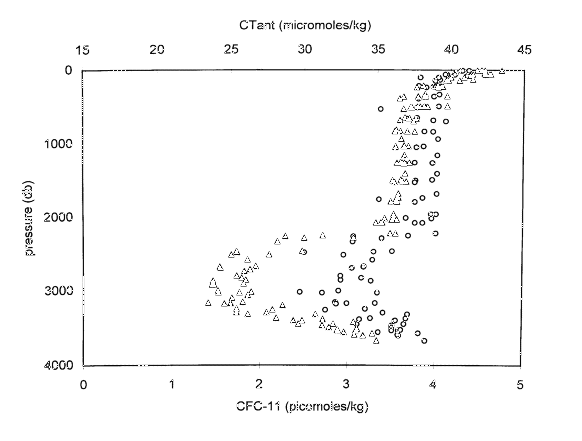
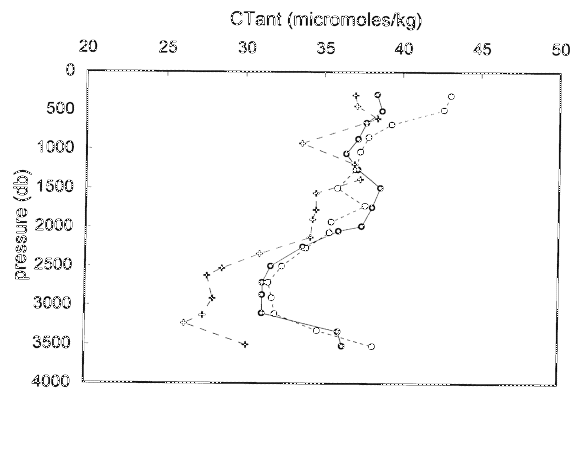
Profiles of CFC-11 and CTant in the central Labrador Sea along AR7W in spring 1995 are shown in Figure 1. A relatively homogeneous layer from 800 to 2000-2200m with = 27.77-27.78 corresponds to the layer sustained by deep convection the previous 3 winters. Below this, the minimum in CFC-11 and CTant shows the core of the NEADW. The increase towards the sea floor is due to the presence of more recently formed DSOW. The 3 layer structure of the central Labrador Sea is clearly resolved by both CFC-11 and CTant. Figure 2 shows depth-binned averages for the central region of WOCE line AR7W for spring of 1993, 1995, and 1997. Although not yet statistically significant, the 1997 profile shows increasing levels in the upper water column restricted to the shallower depths to which more recent convection penetrated. CTant between 1000 and 2000 db appears to have remained relatively constant, consistent with a residual layer from deeper convection in the 1993-1995 period.
The distribution of CTant from Newfoundland to Cape Farewell shows the spreading of newly formed LSW eastwards into the Irminger Sea. LSW can also be seen flowing southwards along the western boundary in the 500-1500db depth range within the western boundary current.
Clarke (1984) estimated that 9.5 Sv of NEADW and 6.5 Sv of DSOW flow around Cape Farewell into the Labrador Sea based on current meter data and a hydrographic section from 1978. When combined with representative levels of CTant taken from this study, 0.3 GtC are estimated to flow into the Labrador Sea within the Western Boundary Undercurrent per year. Assuming a volume flow of between 10 and 26 Sv leaving the Labrador Sea (Lazier and Wright, 1993; McCartney, 1992) for water densities greater than = 27.4 and a depth-integrated average CTant of 35 µmol/kg, one obtains a flow of anthropogenic CO2 of 0.15-0.35 GtC/yr. This represents 7-17 % of the anthropogenic carbon estimated to be entering the global ocean annually and 30- 80% of the net air-sea transfer of CO2 estimated by Takahashi et al. (1999) for the North Atlantic north of 50N. If about 20% of the net air-sea flux is considered as the anthropogenic component, our estimate of the export of the same to the interior of the N. Atlantic implies a residence time for the "sequestered" CO2 in the Labrador Sea region of from 1 to 3 years. Further, it should be noted that this calculation includes only the flow leaving the Labrador Sea southwards along the western boundary and not the eastward flow of LSW into the Irminger Sea shown on the Cape Farewell section. The fate of this eastwards flow is uncertain. These data were collected following a period of intense winter forcing. During such times, the export of newly formed LSW into the northeast Atlantic may be enhanced (Sy et al., 1997). Assuming oxygen saturation at the time of water mass formation may lead to an underestimation of CTant. Uncertainties notwithstanding, these simple calculations suggest that the Labrador Sea water column sees a significant portion of the flux of anthropogenic CO2 to the North Atlantic.
The Brewer/Chen-Millero approach as modified by Gruber et al. (1996) has allowed the estimation of anthropogenic CO2 levels in the Labrador Sea water column from direct measurements of components of the carbonate system. It is sufficiently robust to show the 3 different water masses contributing to the boundary current which ultimately transports CO2 into the deep ocean. A large part of the CO2 which is ultimately sequestered by the high latitude North Atlantic Ocean flows through the Labrador Sea. It is therefore an important region on which to focus.References
Bradshaw, A.L., P.G. Brewer, D.K. Shafer, R.T. Williams (1981), Measurements of total carbon dioxide and alkalinity by potentiometric titration in the GEOSECS program, Earth and Planetary Science Letters, 55, 99-115.
Clarke, R. A. (1984) Transport through the Cape Farewell-Flemish Cap section. Rapports et Proces-Verbaux. Reun. Cons. int. Explor. Mer, 185, 120-130.
Dickson, A. G. and Goyet C. C. (Eds.) (1994) Handbook of methods for the analysis of the various parameters of the carbon dioxide system in seawater, Ver 2, ORNL/CDIAC-74
Gruber, N., Sarmiento, J. L. and Stocker, T. F. (1996) An improved method for detecting anthropogenic CO2 in the oceans. Global Biogeochemical Cycles, 10, 809-837.
Haraldsson, C., Anderson, L. G., Hassellöv, M., Hulth, S., and Olsson, K. (1997) Rapid, high-precision potentiometric titration of alkalinity in ocean and sediment pore waters. Deep-Sea Research, 44, 2031-2044.
Johnson, K. M., King, A. E. and Sieburth, J. McN. (1985) Coulometric TCO2 analyses for marine studies: An introduction. Marine Chemistry, 16, 61-82.
Lazier, J. R. N. (1973) The renewal of Labrador Sea Water. Deep-Sea Research Part I, 20, 341-353.
Lazier, J. R. N. and Wright, D. G. (1993) Annual velocity variations in the Labrador Current. Journal of Physical Oceanography, 23, 659-678.
McCartney, M. and Talley, L. D. (1982) The subpolar mode water of the North Atlantic Ocean. Journal of Physical Oceanography, 12, 1169-1188.
McCartney, M. S. (1992) Recirculating components to the deep boundary current of the North Atlantic. Progress in Oceanography, 29, 283-383.
Swift, J. S. (1984) The circulation of the Denmark Strait and Iceland-Scotland overflow waters in the North Atlantic. Deep-Sea Research Part I, 31, 1339-1355.
Sy, A., Rhein, M., Lazier, J. R. N., Koltermann, K. P., Meincke, J., Putzka, A., and Bersch, M. (1997) Surprisingly rapid spreading of newly formed intermediate waters across the Atlantic Ocean. Nature, 386, 675-679.
Takahashi, T., Takahashi, T. T. and Sutherland, S. C. (1995). An assessment of the role of the North Atlantic as a CO2 sink. Philosophical Transactions of the Royal Society of London. B., 348, 143-152.
Takahashi, T., Wanninkhof, R.H., Feely, R.A., Weiss, R.F, Chipman, D.W., Bates, N., Olafsson, J, Sabine, C., and Sutherland, S.C. (1999). Net sea-air CO2 flux over the global oceans: An improved estimate based on the sea-air pCO2 difference. Extended Abstract, 2nd Int'l Symposium "CO2 in the Oceans", 18-22 Jan 1999, Tsukuba, Japan.